Chance is you never heard of them. But these are some of the safest banks in the World ( source: Global Finance magazine ).
For some can't be said they are big, but they are ruled by very strong banking credo with huge tradition and tailored services for those in the know.
KfW (Germany )
Caisse des Depots et Consignations (CDC)(France)
Nordea(Sweden)
Bank Nederlandse Gemeenten (Netherlands)
Caja de Ahorros y Pensiones de Barcelona (Spain)
Zuercher Kantonalbank (Switzerland)
Svenska Handelsbanken (Sweden)
Landwirtschaftliche Rentenbank (Germany)
BNY Mellon (United States)
Rabobank Group (Netherlands)
Oversea-Chinese Banking Corporation (Singapore)
Landeskreditbank Baden-Wuerttemberg - Foerderbank (Germany)
United Overseas Bank (Singapore)
Nederlandse Waterschapsbank (Netherlands)
Pohjola Bank (Finland)
NRW.Bank (Germany)
Barclays Bank (United Kingdom)
Royal Bank of Canada (Canada)
Intesa Sanpaolo (Italy)
National Australia Bank(Australia)
Bank of Montreal (Canada)
Friday, September 3, 2010

Thursday, September 2, 2010
Our Plan for the Year: Physical Development
Yesterday's blog post title hinted about being frazzled and sady lacking in the "serenity of a Madonna." No, I do not mean the pop diva but the Madonna painted by the masters, she who "no matter out of whose canvas she looks at you, is always serene" (page 34). Always!
My state of frazzilty had nothing to do with our ambitious school program--at least that is what I keep telling myself. Unanticipated events and idiotic scheduling have conspired to squeeze every last drop of time out of the day. Somehow, I scheduled dental cleanings and orthodontic tweaking, two meals on wheels, wanted guests, unwanted guests (escorted by the dogs), meetings, and two desperately needed laptop repairs. On top of all this, my truly wonderful (I really do mean that, no tongue in check intended at all) gave me an early Christmas present--a beautiful, sweet Mac of the snow leopard species. It is going to make my life so much easier once I make it through a humongous learning curve.
Charlotte Mason suggested that decorating our walls with Madonna masterpieces might calm the heart, which just would not mesh with our decor very well. Yesterday, we tried her Plan B with a few modifications, "Let the mother go out to play! If she would only have courage to let everything go when life becomes too tense, and just take a day, or half a day, out in the fields, or with a favourite book, or in a picture gallery looking long and well at just two or three pictures, or in bed, without the children, life would go on far more happily for both children and parents."
I can't really manage half a day, much less three. Mt. Laundry would hit the ceiling and Mt. Dishes would spill over into the back porch. The nearest art gallery involves a 150-mile round trip. The only time I take to my bed is when Mr. Flu pays a visit. Too many books and things and screens already tax my eyeballs, so reading is out. With trips looming in October, I really need to stick to my plan for the school year.
So . . . on the way to the dentist yesterday, we carschooled: doing our audio work (composer study, songs, Spanish, hymns, recitation), copywork and studied dictation, and drawing on the road. Instead of sitting in the waiting room trying to block out the dent-fomercials and squeeze in a few more books, we headed to Swan Lake, whose luscious scenes renewed mind, soul, and body. And, we checked P. E. and nature study off our list!
Over a decade of homeschooling has taught me that we are not superhuman. We cannot do everything nor do it perfectly. We live in the real world and juggle multiple grade levels and/or manage special needs, which means letting somethings go is a must, or have other demanding issues. I believe that every family must adapt to their unique situation. Pamela has autism and aphasia. She needs thinkspace and downtime to be at her best.
I spent last summer pouring over the curriculum plan and dropped many things to make room for Pamela's dynamic thinking curriculum (RDI): dance, drama, grammar, handwriting, Latin, musical instrument lessons, physical education (except for walking), and reading lessons. I omitted books that she had already read and did not replace them with suitable books. I substituted a couple of extremely wordy books with less wordy ones that were no less living. I ignored all of the beautiful, tempting books recommended for the class library. I watered down P. E. to walking.
Pamela has never done well in an organized sports setting. When she attended a YMCA class for homeschoolers in her early teens, she did not track people at all. During the hour of game time, she needed heavy support from me and still had no idea what was going on or what to do. She had no problems with free play in the pool because she loved the water and did whatever her heart delighted. Until she is ready for more advanced sports, I plan to walk with her and, if there happens to be a playground near by, encourage her to explore the equipment.
Now, I understand why she struggled. While Pamela is "big" enough, she is not "old" enough in her social development to enjoy structured games. Mason made a developmentally appropriate distinction between the kind of games children enjoy playing. In fact, Laura Berk quoted research supporting Mason's opinion in Awakening Children's Minds. Mason wrote,
Don't get me wrong. I am all for organized sports and carefully taught instruction. I benefitted from a fantastic P. E. program in high school that motivated slugs like me to run 200 miles in one school year. Not only did our teacher make sure we learned the basics of organized sports, he set up a conditioning program that allowed anyone willing to work hard to get an A. As long as we met the outlined daily benchmarks in P. E. (run two miles and do a given number of situps and pushups) we got a grade of A for the day. All we had to do after that we to improve our fitness test scores from the previous semester. That is not hard to do if you are out of shape from the summer and put forth consistent effort.
The author of our natural history book, who foresaw many concerns we face today, wraps up the importance of physical development nicely,
Ouch!
That means people like me, who play most things badly, no longer have an excuse!
My state of frazzilty had nothing to do with our ambitious school program--at least that is what I keep telling myself. Unanticipated events and idiotic scheduling have conspired to squeeze every last drop of time out of the day. Somehow, I scheduled dental cleanings and orthodontic tweaking, two meals on wheels, wanted guests, unwanted guests (escorted by the dogs), meetings, and two desperately needed laptop repairs. On top of all this, my truly wonderful (I really do mean that, no tongue in check intended at all) gave me an early Christmas present--a beautiful, sweet Mac of the snow leopard species. It is going to make my life so much easier once I make it through a humongous learning curve.
Charlotte Mason suggested that decorating our walls with Madonna masterpieces might calm the heart, which just would not mesh with our decor very well. Yesterday, we tried her Plan B with a few modifications, "Let the mother go out to play! If she would only have courage to let everything go when life becomes too tense, and just take a day, or half a day, out in the fields, or with a favourite book, or in a picture gallery looking long and well at just two or three pictures, or in bed, without the children, life would go on far more happily for both children and parents."
I can't really manage half a day, much less three. Mt. Laundry would hit the ceiling and Mt. Dishes would spill over into the back porch. The nearest art gallery involves a 150-mile round trip. The only time I take to my bed is when Mr. Flu pays a visit. Too many books and things and screens already tax my eyeballs, so reading is out. With trips looming in October, I really need to stick to my plan for the school year.
So . . . on the way to the dentist yesterday, we carschooled: doing our audio work (composer study, songs, Spanish, hymns, recitation), copywork and studied dictation, and drawing on the road. Instead of sitting in the waiting room trying to block out the dent-fomercials and squeeze in a few more books, we headed to Swan Lake, whose luscious scenes renewed mind, soul, and body. And, we checked P. E. and nature study off our list!
Over a decade of homeschooling has taught me that we are not superhuman. We cannot do everything nor do it perfectly. We live in the real world and juggle multiple grade levels and/or manage special needs, which means letting somethings go is a must, or have other demanding issues. I believe that every family must adapt to their unique situation. Pamela has autism and aphasia. She needs thinkspace and downtime to be at her best.
I spent last summer pouring over the curriculum plan and dropped many things to make room for Pamela's dynamic thinking curriculum (RDI): dance, drama, grammar, handwriting, Latin, musical instrument lessons, physical education (except for walking), and reading lessons. I omitted books that she had already read and did not replace them with suitable books. I substituted a couple of extremely wordy books with less wordy ones that were no less living. I ignored all of the beautiful, tempting books recommended for the class library. I watered down P. E. to walking.
Pamela has never done well in an organized sports setting. When she attended a YMCA class for homeschoolers in her early teens, she did not track people at all. During the hour of game time, she needed heavy support from me and still had no idea what was going on or what to do. She had no problems with free play in the pool because she loved the water and did whatever her heart delighted. Until she is ready for more advanced sports, I plan to walk with her and, if there happens to be a playground near by, encourage her to explore the equipment.
Now, I understand why she struggled. While Pamela is "big" enough, she is not "old" enough in her social development to enjoy structured games. Mason made a developmentally appropriate distinction between the kind of games children enjoy playing. In fact, Laura Berk quoted research supporting Mason's opinion in Awakening Children's Minds. Mason wrote,
Cricket, tennis, and rounders are the games par excellence if the children are old enough to play them, both as giving free harmonious play to the muscles, and also as serving the highest moral purpose of games in bringing the children under the discipline of rules; but the little family we have in view, all of them under nine, will hardly be up to scientific games. Races and chases, 'tag,' 'follow my leader,' and any romping game they may invent, will be more to their minds. (Page 83)
Don't get me wrong. I am all for organized sports and carefully taught instruction. I benefitted from a fantastic P. E. program in high school that motivated slugs like me to run 200 miles in one school year. Not only did our teacher make sure we learned the basics of organized sports, he set up a conditioning program that allowed anyone willing to work hard to get an A. As long as we met the outlined daily benchmarks in P. E. (run two miles and do a given number of situps and pushups) we got a grade of A for the day. All we had to do after that we to improve our fitness test scores from the previous semester. That is not hard to do if you are out of shape from the summer and put forth consistent effort.
The author of our natural history book, who foresaw many concerns we face today, wraps up the importance of physical development nicely,
The circle of nature's seasons and the discipline of seasonal routine were once signals for individual activity, but the seasons of today involve group activity. With the addition of competition and spectator sports, we now specialize in group sitting and group watching. The benefits of watching a three-hour baseball game on television or at the ball park, can never equal a few minutes of play at the game yourself. Theodore Roosevelt, who was one of the last of America's great individualists, said, "It is far more important that a man should play something himself, even if he plays it badly, than that he should go to see someone else play it well."
Ouch!
That means people like me, who play most things badly, no longer have an excuse!
Handshakes Reveal More than You Think!

Not too surprisingly, your handshake reveals much about confidence and trust. So what does it take to execute one well? Based on recent findings by British scientist, Geoffrey Beattie twelve things determine the quality of a handshake.
The formula for the perfect handshake looks like this:
PH = √(e2 + ve2)(d2) + (cg + dr)2 + p{(4< s >2)(4< p >2)}2 + (vi + t + te)2 + {(4< c >2 )(4< du >2)}2
Here’s a key to the equation, including proper levels of each factor on a 1-5 scale:
(e): eye contact (1=none; 5=direct) — 5
(ve): verbal greeting (1=totally inappropriate; 5=totally appropriate) — 5
(d): Duchenne smile — smiling in eyes and mouth, plus symmetry on both sides of face, and slower offset (1=totally non-Duchenne smile (false smile); 5=totally Duchenne) — 5
(cg): completeness of grip (1=very incomplete; 5=full) — 5
(dr): dryness of hand (1=damp; 5=dry) — 4
(s): strength (1= weak; 5=strong) — 3
(p): position of hand(1=back towards own body; 5=other person’s bodily zone) — 3
(vi): vigor (1=too low/too high; 5=mid) — 3
(t): temperature of hands (1=too cold/too hot; 5=mid) — 3
(te): texture of hands (1=too rough/too smooth; 5=mid) — 3
(c): control (1=low; 5=high) — 3
(du): duration (1= brief; 5=long) — 3
Sensory input from thermal and pressure receptors during a handshake is sent to your brain's parietal lobe. The message travels to deeper areas of the limbic system for an emotional interpretation to judge how the shake felt, David Givens notes.
“The rules for men and women are the same: right hand, a complete grip and a firm squeeze (but not too strong) in a mid-point position between yourself and the other person, a cool and dry palm, approximately three shakes, with a medium level of vigour, held for no longer than two to three seconds, with eye contact kept throughout and a good natural smile with a slow offset with, of course, an appropriate accompanying verbal statement, make up the basic constituent parts for the perfect handshake,” notes Beattie.
"Since in much of the world a handshake is both a visual and a tactile index of your concern for other people," Givens points out. "A rule of thumb is not to hold back." Givens reveals many tips about what is expected in your handshake when you visit other countries.
How do you rate your current handshake? Tap into these strategies as you meet an important contact or go for that critical interview!
CEO's business
Reminder for the initiated.
: search for solutions
: make decisions
: resolve conflicts
: financial planning
: company representation
: leading
: reporting to stakeholders
: coordinates
: appoints
: controls
: negotiate
: Buys
: Sells
: Travel
: maintain relationships
: gives green light
: assemble teams
: creates rules/procedures
: define organization 's chart
: generate initiatives
: complies with the law
: networking / socializing
: investment planning
: define strategy and vision
: delegation
: gives presentations
: mentoring
: conducts daily operations
: goal settting
: gives advices
: search for solutions
: make decisions
: resolve conflicts
: financial planning
: company representation
: leading
: reporting to stakeholders
: coordinates
: appoints
: controls
: negotiate
: Buys
: Sells
: Travel
: maintain relationships
: gives green light
: assemble teams
: creates rules/procedures
: define organization 's chart
: generate initiatives
: complies with the law
: networking / socializing
: investment planning
: define strategy and vision
: delegation
: gives presentations
: mentoring
: conducts daily operations
: goal settting
: gives advices
Wednesday, September 1, 2010
Wordless Wednesday: What to Do When You Are Frazzled!
 Hanging Out
at Swan Lake
While David
Is at the
Dentist


Surreal Photo Manipulation: 40 Amazing Artwork
Surreal photo is basically displays of a designer’s rich imagination of subjects which then injected into real pictures. Most of these surreal pictures are captivating be it pleasant or not because it is not what we experience in our daily life hence it is out of norm. Given it is not an event we could not possibly experience, it leaves a huge dimension for viewers to interpret what does the
Tuesday, August 31, 2010
Our Plan for the Year: Natural History
I often visited a friend who lived in Maryland when I was in college. Her family lived in the woody hills near the Appalachian Trail (no, they were not Appalachian-Americans). Whenever a bunch of us went walking, she could tell us about the plants and animals. Although I was well-educated and was on track to graduate from a fairly prestigious school, I felt so ignorant about nature.
 I couldn't even blame it on being a city-girl because I had spent my high school years in rural Newfoundland--the nearest stoplight was an hour-and-a-half away. My siblings and I did things like build a cabin in the woods, or a distant facsimile of one. We went fishing, picked blueberries, got stuck in the bog, combed the beach for junk, etc. Our school extra-curricular activities included a fishing derby, camping at a bird sanctuary, and heading out to a nature park. One teacher even took us hobbit-hunting down at the docks on the one nice day of Spring--there was only one. As much time as we spent outdoors, we didn't know nature like my friend did.

 I used to think that her parents made her learn all that stuff because they were teachers. Her mother was a librarian, and her father taught driver's ed and coached after school. But, now I think it was because her father grew up farming. Her parents grew their own vegetables and her dad even kept bees. They were very close to the land, well-aware of the passing of the seasons. Their old-fashioned lifestyle reminds me of a quote from the one book we are reading for natural history,
Spending a little amount of time studying natural history is one element of living the full life. Yesterday Pamela and I studied some empty bird nests my father found in his shed. When the birds return next Spring, my dad will let us know so we can study the life cycle of birds first hand. What kind of birds will we see? Pamela thinks they are robins, but I suspect they are sparrows or finches.


 After we wrapped up our study on the life cycle of painted lady butterflies, Pamela found a dead cloudless sulphur butterfly, so we started a list of butterflies in the back of her nature notebook. We spotted a common buckeye and, later this week, she will record her observations and add that to her list. We started a list of trees too, for, after studying winter buds, we will be able to compare the blossoms of peach, pear, and dogwood trees next Spring.

Yesterday, we came across another mystery: we found a branch of our peach sapling covered in webbing and small dark eggs sprinkled all over the leaves. We are keeping an eye on that while we wait for our ladybug kit to arrive.


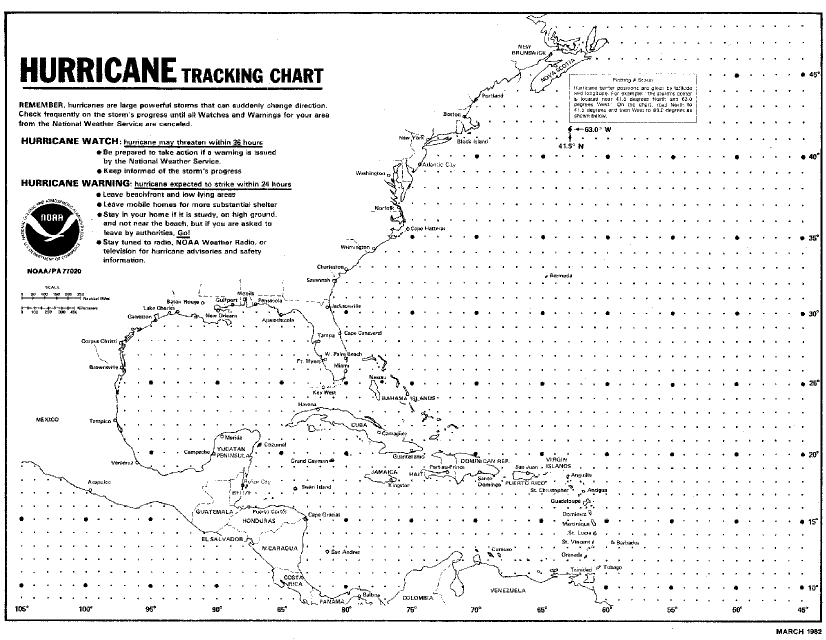
The study of natural history also includes the study of the sky. Right now, we are tracking Hurricane Earl on an NOAA chart we printed out. Pamela's first reaction when she saw the track was, "NOT SOUTH CAROLINA!" Her second one was, "Not Louisiana!" (Steve's family live there). We are also keeping weekly weather records and Pamela noticed that last week was drier than the week before and the temperatures have dropped as well. We will be spending the rest of the school year collecting weather data to sharpen Pamela's understanding of the change of seasons.
What is natural history? It is paying attention to what is happening outdoors with careful recordings of day by day observations. It is thinking about the observations and making corrections. It means taking one's time before making any rash conclusions. It is developing a sense of place, which is what we are doing in our corner of the world. When we walk, I help Pamela hone her sense of direction. We notice all the mushrooms popping up after that rainy spell in August. We see butterflies hanging out at butterfly bushes and squirrels chasing each other around tree trunks. We observe where the moss grows along the brick walls and listen for our favorite birds. We will do all these things and more as we explore our turf in a loosely structured plan that will ebb and flow with the changing seasons.
Our natural history book echoes what Charlotte Mason wrote long before he was born,
 I couldn't even blame it on being a city-girl because I had spent my high school years in rural Newfoundland--the nearest stoplight was an hour-and-a-half away. My siblings and I did things like build a cabin in the woods, or a distant facsimile of one. We went fishing, picked blueberries, got stuck in the bog, combed the beach for junk, etc. Our school extra-curricular activities included a fishing derby, camping at a bird sanctuary, and heading out to a nature park. One teacher even took us hobbit-hunting down at the docks on the one nice day of Spring--there was only one. As much time as we spent outdoors, we didn't know nature like my friend did.
 I used to think that her parents made her learn all that stuff because they were teachers. Her mother was a librarian, and her father taught driver's ed and coached after school. But, now I think it was because her father grew up farming. Her parents grew their own vegetables and her dad even kept bees. They were very close to the land, well-aware of the passing of the seasons. Their old-fashioned lifestyle reminds me of a quote from the one book we are reading for natural history,
By having others think for us and design our work and pleasure, we now live comfortably without certain knowledges that only a century ago were essential. In losing our need to know so many things, our list of general knowledge has at last become exceedingly small; it equips us well for business, less well for the sciences, and very poorly for living the full life.
Spending a little amount of time studying natural history is one element of living the full life. Yesterday Pamela and I studied some empty bird nests my father found in his shed. When the birds return next Spring, my dad will let us know so we can study the life cycle of birds first hand. What kind of birds will we see? Pamela thinks they are robins, but I suspect they are sparrows or finches.


 After we wrapped up our study on the life cycle of painted lady butterflies, Pamela found a dead cloudless sulphur butterfly, so we started a list of butterflies in the back of her nature notebook. We spotted a common buckeye and, later this week, she will record her observations and add that to her list. We started a list of trees too, for, after studying winter buds, we will be able to compare the blossoms of peach, pear, and dogwood trees next Spring.
Yesterday, we came across another mystery: we found a branch of our peach sapling covered in webbing and small dark eggs sprinkled all over the leaves. We are keeping an eye on that while we wait for our ladybug kit to arrive.


"In the days of the almanacs, when man lived close to the earth and the sky dictated every move, there was a beautiful and profound understanding of time and life and the spiritual connection between the two." Eric Sloane
The study of natural history also includes the study of the sky. Right now, we are tracking Hurricane Earl on an NOAA chart we printed out. Pamela's first reaction when she saw the track was, "NOT SOUTH CAROLINA!" Her second one was, "Not Louisiana!" (Steve's family live there). We are also keeping weekly weather records and Pamela noticed that last week was drier than the week before and the temperatures have dropped as well. We will be spending the rest of the school year collecting weather data to sharpen Pamela's understanding of the change of seasons.
What is natural history? It is paying attention to what is happening outdoors with careful recordings of day by day observations. It is thinking about the observations and making corrections. It means taking one's time before making any rash conclusions. It is developing a sense of place, which is what we are doing in our corner of the world. When we walk, I help Pamela hone her sense of direction. We notice all the mushrooms popping up after that rainy spell in August. We see butterflies hanging out at butterfly bushes and squirrels chasing each other around tree trunks. We observe where the moss grows along the brick walls and listen for our favorite birds. We will do all these things and more as we explore our turf in a loosely structured plan that will ebb and flow with the changing seasons.
Our natural history book echoes what Charlotte Mason wrote long before he was born,
"Nature never did betray the heart that loved her";––
and, in return for our discriminating and loving observation, she gives us the joy of a beautiful and delightful intimacy, a thrill of pleasure in the greeting of every old friend in field or hedgerow or starry sky, of delightful excitement in making a new acquaintance.
But Nature does more than this for us. She gives us certain dispositions of mind which we can get from no other source, and it is through these right dispositions that we get life into focus, as it were; learn to distinguish between small matters and great, to see that we ourselves are not of very great importance, that the world is wide, that things are sweet, that people are sweet, too; that, indeed, we are compassed about by an atmosphere of sweetness, airs of heaven coming from our God. Of all this we become aware in "the silence and the calm of mute, insensate things." Our hearts are inclined to love and worship; and we become prepared by the quiet schooling of Nature to walk softly and do our duty towards man and towards God. (Page 98)
Subscribe to:
Posts (Atom)